



The Prostate
The Prostate: Function and DiseasesFrom the size of an almond in puberty, due to hormonal signals, the prostate grows in size. It grows to the size and shape of a walnut and weighs about 20 grams. Almost all of this mass develops during puberty in response to hormonal changes associated with maturation. The prostate literally doubles in size during puberty. If a man is lucky, and some are, the prostate never again undergoes any changes in size. The prostate is located in front of the rectum, it is composed of three lobes or sections, enclosed side by side in a capsule. The urethra is a tube which empties the bladder, passes over the middle lobe. Many things can cause the prostate to enlarge. Sometimes enlargement may be the result of infection, inflammation, cancer, and/or hypertrophy. When these lobes of the prostate enlarge they can obstruct the flow of urine , causing both misery and discomfort. The prostate gland's function is to produce part of the fluid for semen, this fluid transports the sperm.
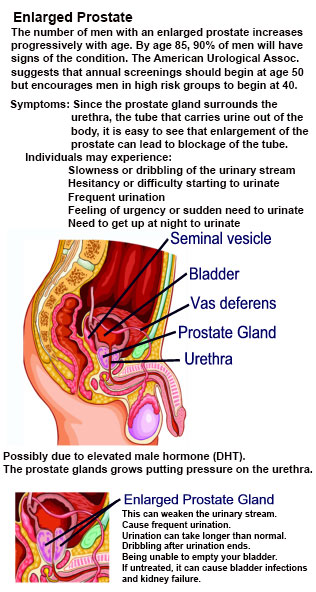
The following symptoms and problems are based upon published symptoms and problems as recognized and published by http://www.nlm.nih.gov/medlineplus/ency/article/000381.htm and http://men.webmd.com/prostate-enlargement-bph/benign-prostatic-hyperplasia-bph-symptoms and http://men.webmd.com/prostate-problems
The most common symptoms of a prostate problem are:
*incontinence
* hesitant, interrupted or reduced urinary stream
* the urgent need to urinate less than 2 hours after you finished urinating
* dribbling of urine, especially after urinating
* feeling that you push or strain to begin urination
* awaken and urinate multiple times at night
* experience decreased desire and/or sexual dysfunction
The most common prostate problems are:
* benign prostatic hyperplasia (BPH)
* prostatitis or inflamation of the prostate
* prostate cancer or tumor - 200,000 new cases are diagnosed each year in the US
Nobody knows the basic cause of BPH. However research shows that testosterone, the male hormone, or dihydrotestosterone, a hormone produced when testosterone breaks down in a man's body, may cause the prostate to keep growing. Another theory is that changes in the ratio of testosterone and estrogen (female hormone) may occur as men age and therefore cause the prostate to grow.
Some over the counter medications for colds or allergies can drastically worsen the symptoms of BPH.
BPH or benign prostatic hyperplasia is a non-cancerous enlargement of the prostate gland. BPH symptoms result when the enlarging prostate puts pressure on the urethra where it runs through the prostate. This non-cancerous enlargement of the prostate gland causes unpleasant symptoms such as urinary frequency, urgency, and weak urinary flow.2 BPH is the most common prostate problem among men. It is more common in older men, due to aging a man's prostate naturally enlarges. Starting at approximately age 40, the levels of a hormone prolactin begin increasing in men, this in turn stimulates an increased production of the enzyme 5-alpha reductase. As a result the metabolism of testosterone increases, resulting in an increase of the metabolic byproduct di-hydro-testosterone or DHT. Dihydrotestosterone (DHT) is a hormone that is produced from testosterone via the enzyme 5-alpha-reductase. DHT is the most potent naturally occurring androgen (male hormone)—in fact, scientists have estimated that DHT’s growth-promoting effects on prostate tissue are 10 times more potent than testosterone.1 Dihydrotestosterone is crucial to the development of normal male characteristics. Elevated levels of DHT in adult men, however, may have numerous deleterious or unwanted effects.3 Unfortunately for men between the age of 40 and 59, nearly 60% can be shown to already be suffering from benign prostatic hyperplasia. This usually does not present a noticeable problem until after the age of 50. By the age of 80, however, some 85% of all men suffer from one or more symptoms of BPH. As the prostate enlarges, the layer of tissue surrounding it stops it from expanding, causing the gland to press against the urethra.The bladder wall becomes thicker and irritated. The bladder begins to contract when it contains small amounts of urine, causing more frequent urination. Eventually, the bladder weakens and is unable to empty itself and urine remains in the bladder. The narrowing of the urethra and partial emptying of the bladder lead to many of the problems associated with BPH. It is important to note that BPH may not lead to cancer; however, a man can and may have BPH and cancer at the same time.Prostatitis is an inflammation of the prostate gland. The inflammatory process can be infectious or inflammatory in the origin. Prostatitis is caused by a bacterial infection in only 5% to 10% of all cases. The bacteria is similar to those which cause other types of urinary tract infections. A majority of patients, have no evidence of bacteria in their prostates yet are thought to carry microorganisms such as Chlamydia or Ureaplasma. Approximately 50 % of men diagnosed with prostatitis are prescribed antibiotics for the treatment of the complex of symptom prostatitis despite the fact that they have no evidence of any actual infection. Prostatitis can develop from untreated BPH. An excellent resource for the causes of prostatitis can be located at www.prostatitis.org.
Prostate cancer, is the third leading cause of cancer death in American men, is a malignant tumor that often begins on the outer part of the prostate gland. As a prostate tumor grows, it may spread to the inner part of the prostate gland. Treatment options for prostate cancer include monitoring, hormonal therapy, radiation, brachytherapy and surgery.
Physicians generally detect prostate cancer using one of three tests. These are: the digital rectal exam (DRE); the prostate-specific antigen test (PSA test); or during a surgical procedure known as (TURP) transurethral resection of the prostate. A high PSA test may indicate an increased risk of developing prostate cancer. Despite this, a high PSA does not necessarily mean cancer is present; as many men with BPH also have elevated PSA levels.
Non-invasive evaluation of prostate
cancer can be performed
with standard MRI.
MRI accuracy is 89%. Despite the fact that MRI
tends to overstage the tumor. Most physicians feel MRI
does not provide added
information over the results
available from surgically
invasive prostate biopsy
pathology and PSA data.4
Recent development and use of MR spectroscopic imaging (MRI-S) expands the diagnostic assessment of prostate cancer beyond the traditional information provided by a standard MRI. (5,6,7) The new technology MRI-S uses multiple coils to image the prostate.
Reference Materials used for the above are provided below:
1. Deslypere JP, Young M, Wilson JD, McPhaul MJ. Testosterone and 5 alpha-dihydrotestosterone interact differently with the androgen receptor to enhance transcription of the MMTV-CAT reporter gene. Mol Cell Endocrinol. 1992 Oct;88(1-3):15-22.
2. Comhaire F, Mahmoud A. Preventing diseases of the prostate in the elderly using hormones and nutriceuticals. Aging Male. 2004 Jun;7(2):155-69.
3. Severi G, Morris HA, MacInnis RJ, et al. Circulating steroid hormones and the risk of prostate cancer. Cancer Epidemiol Biomarkers Prev. 2006 Jan;15(1):86-91.
4. Andrew C Peterson, MD, FACS, et. al.; Urologic Imaging Without X-rays: Ultrasound, MRI, and Nuclear Medicine., Jan 4, 2007, http://emedicine.medscape.com/article/455553-overview#showall
5. Kurhanewicz J, Vigneron DB, Hricak H, et al: Prostate cancer: metabolic response to cryosurgery as detected with 3D H-1 MR spectroscopic imaging. Radiology 200:489-96, 1996.
6. Parivar F, Hricak H, Shinohara K, et al: Detection of locally recurrent prostate cancer after cryosurgery: evaluation by transrectal ultrasound, magnetic resonance imaging, and three-dimensional proton magnetic resonance spectroscopy. Urology 48:594-9, 1996.
7. Kurhanewicz J, Vigneron DB, Hricak H, et al: Three-dimensional H- 1 MR spectroscopic imaging of the in situ human prostate with high (0.24-0.7-cm3) spatial resolution. Radiology 198:795-805, 1996.
About 30 million men suffer from benign prostatic hypertrophy (BPH). BPH is the most common disorder of the prostate1 and it is the most common diagnosis by urologists for male patients age 45-74.2
There is a 50 percent chance that you will have prostate problems or symptoms by the time you are 60.3
Each year more than 500,000 men in North America have prostate surgery; and more than a billion dollars a year is spent on the treatment of prostate problems.
Prostate surgery often results in both incontinence and impotence and can result in men living a life without sexual intercourse.
One prescription pharmaceutical drug for treating prostate problems, is associated with sexual dysfunction and male breast enlargement.
Another prescription pharmaceutical drug for treating prostate problems, is associated with both nasel congestion and cough (incidence is double that of placebo).
Saw palmetto is not an effective remedy for enlarged prostate based upon information published by: Bent S, Kane C, et al. "Saw palmetto for benign prostatic hyperplasia." New England Journal of Medicine, 2006; 354:557-66.
1. Issa M, Marshall F. Contemporary Diagnosis and Management of Diseases of the Prostate. 3rd ed. Newtown, Pa:Handbooks in Healthcare Co; 2005.
2. Contemporary Urology/Urology Times 2005 Fact Book. Prepared by Advanstar Medical Economics Healthcare Communications Secondary Research Services.
3. American Urological Association Education and Research, Inc. Guideline on the Management of Benign Prostatic Hyperplasia (BPH). 2003.
Nature has given us a natural remedy to support good prostate health.
We buy Hybrids to drive. We make our homes and cities green. Isn’t it time to take care of your health and help your body naturally? Then make the natural choice for your Prostate health! Best Prostate™